Key Takeaways
- 1. The Great AI Paradox is Real and Growing. Widespread adoption (over 80%) has created a false sense of progress. In reality, a staggering gap exists between tactical tool usage and strategic business value, with fewer than 20% of companies successfully integrating AI to drive measurable ROI. Simply using AI is no longer a competitive advantage; mastering it is.
- 2. Your Goal is Maturity, Not Just Adoption. The most critical question isn’t if you use AI, but how. Research shows 83% of organizations are stuck in the early “Nascent” or “Emerging” stages, using AI for simple tasks. The real value is unlocked by intentionally climbing the ladder to the “Integrated” and “Prescriptive” stages, where AI provides predictive guidance.
- 3. Foundational Gaps are the Primary Barrier. Progress is consistently blocked by fundamental weaknesses in four key pillars. Without a documented strategy, an integrated technology stack built on clean data, upskilled people, and a clear framework for measuring business outcomes (not just outputs), any AI initiative is destined to underperform.
- 4. You Must Shift from Vanity Metrics to Business Impact. Stop tracking outputs like “number of blogs written” or “hours saved.” To prove the value of AI to the C-suite, you must rigorously connect every initiative to the metrics that matter: reduced Customer Acquisition Cost (CAC), increased pipeline velocity, and higher Customer Lifetime Value (LTV).
- 5. The Next Wave of AI is Agentic—Prepare Now. The current landscape of Generative and Predictive AI is just the beginning. The future of marketing lies with autonomous, agentic systems that can plan and execute entire campaigns. Building a mature foundation across the four pillars today is the only way your organization will be prepared to compete in the agentic era of tomorrow.
The B2B AI Marketing Framework for Driving Measurable ROI
Artificial Intelligence isn’t just coming; it’s here. It’s embedded in our inboxes, our content calendars, and our campaign builders. In a post-pandemic B2B landscape defined by digital-first engagement and intense pressure on CMOs to prove their contribution to revenue, AI has arrived as a beacon of promise. For B2B marketers, the explosion of AI tools has heralded a new era of unprecedented efficiency and insight, from automating routine tasks to enabling hyper-personalized customer experiences that can significantly boost engagement and conversion rates. And on the surface, AI adoption is a massive success story. A new synthesis of industry data confirms it: a staggering 81% of B2B marketing organizations now use generative AI tools in their day-to-day workflows. [2] Yet, this headline number—a figure that suggests near-total market saturation—hides a critical and dangerous problem. It has created what can only be described as the Great AI Paradox:
A vast and growing chasm between tool usage and strategic business value, where high adoption rates fail to translate into proportional gains in revenue or competitive edge.
While nearly nine out of ten B2B companies have embraced AI, the data reveals a shocking disconnect: only 19% of marketing leaders report that they have successfully integrated AI into their core marketing strategy to drive discernible business outcomes. [1] Most B2B marketers are driving a high-performance engine without a steering wheel, a map, or a dashboard. They’re moving faster than ever, but they are not necessarily moving in the right direction, often resulting in fragmented efforts that dilute potential returns.
The challenge today isn’t about adopting AI; it’s about maturing with it. Companies are stuck in a cycle of tactical experimentation, mistaking activity for progress. The real competitive advantage lies in escaping this cycle.
This isn’t a failure of technology. It is a failure of organizational maturity. The market leaders of tomorrow will not be the companies that simply use AI, but those who truly master it. Victory will go to the organizations that intentionally climb the ladder of AI maturity, transforming AI from a tactical novelty into an indispensable, predictive engine for growth. This deep-dive analysis unpacks this paradox, provides a clear diagnostic framework to benchmark your own organization, and explores emerging trends like agentic AI systems that autonomously execute multi-step campaigns. It offers an actionable roadmap to finally close the gap between AI activity and business impact, complete with expanded examples and case studies for practical application.
The State of Play: High Adoption, Low Impact
To understand where we’re going, we must first be brutally honest about where we are. The industry is in a state of flux, defined by mass adoption, deep confusion, and a concerning absence of meaningful measurement.
81% Adoption: AI Is Now Table Stakes, Not a Differentiator
The barrier to entry for AI is virtually non-existent, fueling its rapid saturation. The vast majority of this adoption is centered on one specific, highly accessible class of technology: Generative AI. Tools built on Large Language Models (LLMs) like GPT-4 and image diffusion models have become the go-to assistants for top-of-funnel tasks: brainstorming blog ideas, drafting social media copy, summarizing research, writing first-draft emails, and even creating ad creatives. [2] In fact, 75% of B2B marketers are already using AI for content creation, with 41% employing generative AI to build more creative campaigns and 35% using it to gain competitive insights. [4] These are real, tangible efficiency gains, but they are no longer a competitive advantage. When every competitor can generate content 50% faster, the only thing that changes is the volume of noise in the market. The real, strategic value of AI lies in the sophisticated, down-funnel applications that remain largely untapped, such as predictive lead scoring that can increase conversion rates by up to 35% or automated personalization that reduces CAC by 10-20%. [14] Relying on Generative AI for basic content generation is like using a supercomputer as a simple calculator—it works, but you’re missing the entire point, especially as advanced applications like agentic AI begin to emerge, allowing for autonomous decision-making in complex scenarios.
The 62% Measurement Gap: A Black Box of ROI
The most critical finding from recent data is the widespread inability to measure AI’s impact. Most organizations cannot connect their AI investment—in licenses, training, and time—to the metrics that matter to the C-suite: pipeline growth, customer acquisition cost (CAC), or customer lifetime value (LTV). [6] For instance, while 61% of CMOs feel rising pressure to prove ROI, fewer than half are confident in their measurement systems, highlighting a persistent challenge in quantifying AI’s contributions [6]. A full 62% have no formal framework to measure their ROI [3]. Why? Because they are measuring outputs, not outcomes. They track vanity metrics like:
- Number of blogs published per week.
- Hours “saved” on content creation.
- Volume of social media posts scheduled.
This measurement gap creates a dangerous vulnerability. Without a clear line to revenue, AI spending remains an act of faith, not a defensible business strategy. It becomes a prime target for budget cuts during the next economic downturn and leaves marketing leaders struggling to justify its cost to a skeptical CFO who speaks the language of numbers, not novelty. To illustrate, recent surveys show that only 11% of businesses report measurable gains from most AI initiatives, underscoring the need for more robust ROI frameworks. [7] The data reveals a clear disconnect. While adoption of AI tools is nearly universal, the ability to integrate them strategically and measure their impact on business outcomes remains rare.
19% Strategic Integration: Stuck in the Tactical Trap
True strategic integration means AI isn’t just a content-writing tool; it’s the central nervous system of the entire marketing function. It informs budget allocation, drives hyper-personalization at scale, predicts lead quality to focus sales efforts, and optimizes campaigns in real-time. [16] However, with only 19% achieving this level, the fact that so few have reached this stage highlights the tactical trap where most companies live. [1] They are using AI to do the same old things, just a little faster. They haven’t yet used it to do entirely new, transformative things, such as leveraging predictive analytics to forecast market trends or automate multi-channel campaigns with agentic systems. This reality leads to a stark forecast, a Strategic Planning Assumption: By 2027, B2B firms that fail to advance beyond tactical AI usage will face a 25% decline in marketing efficiency relative to their more mature competitors. [10] The initial productivity boost will evaporate, leaving them outpaced by leaner, more strategic organizations that have successfully weaponized data and AI, potentially unlocking 15% revenue growth as seen in leading adopters. [11] 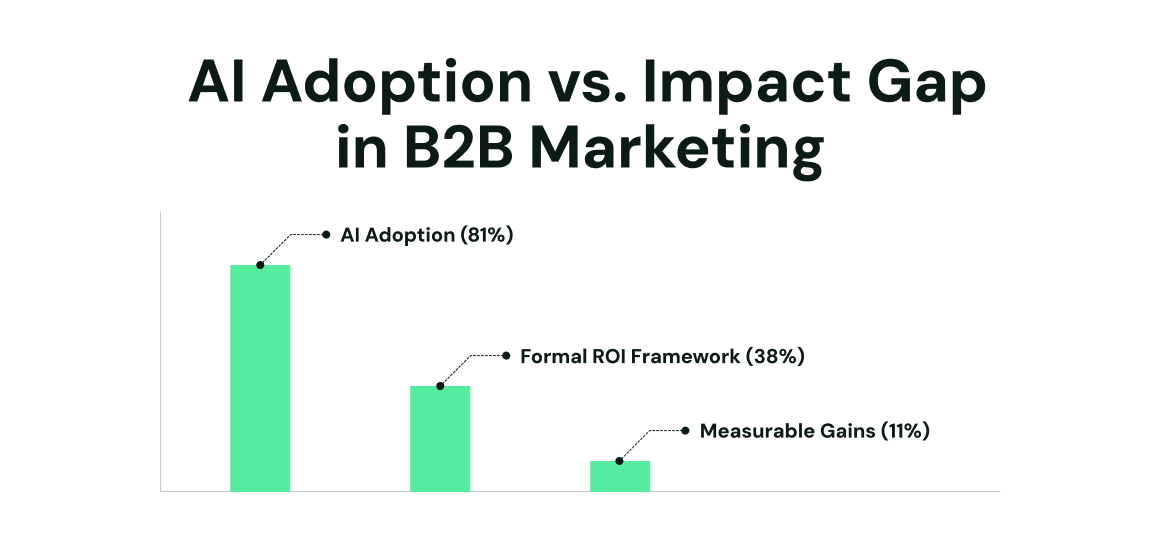 This chart highlights the core paradox in B2B marketing’s use of AI. While a vast majority of marketers are actively using AI tools for tasks like content creation, very few have the frameworks in place to measure the financial impact, resulting in a shockingly low percentage reporting tangible business gains. Nguồn: Dữ liệu benchmark tổng hợp [2, 3, 7, 8].
Lộ trình đầy đủ của bạn tới sự Trưởng thành AI
Hiểu được vị trí của bạn là bước đầu tiên. Nâng cấp đòi hỏi hành động có chủ đích. Dưới đây là lộ trình rõ ràng, có phased, để dẫn dắt hành trình của bạn từ hỗn loạn chiến thuật đến sự rõ ràng chiến lược, mở rộng với thời gian, KPI và các trường hợp thử nghiệm để triển khai.
Phase 1: Moving from Nascent to Emerging
Mục tiêu của bạn ở đây là đưa trật tự vào sự hỗn loạn của quá trình thử nghiệm.
- Thiết lập Nhóm Nhiệm vụ AI liên chức năng:Họp thành một nhóm nhỏ, linh hoạt có đại diện từ marketing, bán hàng, IT và pháp lý. Nhiệm vụ đầu tiên không phải đổi mới mà là điều tra. Họ phải lập danh sách tất cả các công cụ AI đang được sử dụng và tiến hành đánh giá nhanh các rủi ro ngay tại chỗ (an ninh dữ liệu, tính nhất quán thương hiệu). Đặt KPI: Hoàn thành kiểm toán trong 30 ngày.
- Phân bổ Ngân sách Dự án Chính thức: Dành ngân sách cụ thể, vừa phải cho một chương trình thí điểm có cấu trúc. Vai trò này sẽ hợp pháp hóa nỗ lực và đưa nó từ một dự án shadow IT thành một sáng kiến kinh doanh được phê duyệt. Ví dụ: ngân sách 10.000 USD để thử nghiệm các công cụ cá nhân hóa.
- Xác định một Thông số Thành công Đơn giản và Rõ ràng: Trước khi thí điểm bắt đầu, chọn một dự án với một kết quả có thể đo lường trực tiếp gắn với một mục tiêu kinh doanh. Ví dụ: “Sử dụng công cụ AI để cá nhân hóa tiêu đề email cho chiến dịch hội thảo trực tuyến sắp tới nhằm tăng tỷ lệ mở lên 15% so với mức trung bình lịch sử.” Điều này tạo ra một chiến thắng nhỏ, có thể chứng minh.
- Case study: Một công ty phần mềm B2B đã chứng kiến một sự tăng 20% trong tương tác sau một thí điểm tương tự [22].
Phase 2: Moving from Emerging to Integrated
Mục tiêu ở đây là mở rộng các thành quả nhỏ thành một chiến lược đồng bộ và có tác động.
- Phát triển một Chiến lược Marketing AI 12 Tháng Chính thức: Dựa trên bài học từ thí điểm thành công của bạn, tạo ra chiến lược được ghi nhận như đã thảo luận ở Trụ cột 1. Văn bản này phải bao gồm các mục tiêu rõ ràng, lộ trình công nghệ (bao gồm kế hoạch hợp nhất dữ liệu), kế hoạch đào tạo và nâng cao kỹ năng chính thức, và một mô hình quản trị. Đạt phê duyệt từ lãnh đạo cấp cao. Bao gồm KPI như tăng 15% chất lượng lead.
- Thực hiện Kiểm tra Toàn diện MarTech: Lập bản đồ toàn bộ hệ thống công nghệ marketing và bán hàng của bạn. Mục tiêu là xác định các rào cản dữ liệu và xây dựng kế hoạch kết nối các hệ thống lõi (ví dụ: CRM, Nền tảng tự động hóa Marketing, Phân tích Web), tạo nền tảng cho CDP trong tương lai. Thời gian: 3 tháng cho thẩm định và lập kế hoạch tích hợp.
- Thực hiện Chương trình Nâng cao Kỹ năng Chính thức: Đầu tư vào đào tạo có cấu trúc, theo vai trò cho nhóm của bạn. Điều này vượt ra ngoài “prompting 101” và bao gồm đào tạo cho vai trò Marketing Technologist nổi lên, tập trung vào quản lý dữ liệu, phân tích và giám sát mô hình AI. Liên kết với các nền tảng hàng đầu để cấp chứng chỉ; mục tiêu hoàn thành cho 80% đội ngũ trong 6 tháng.
- Định lượng Kết quả Kinh doanh, Không Chỉ Đầu ra: Xây dựng bảng điều khiển theo dõi CAC, chuyển đổi MQL-to-SQL, vận tốc đường ống và suy giảm — tất cả gắn với các sáng kiến AI. Sử dụng các công cụ như Google Analytics hoặc Tableau cho trực quan.
Phase 3: Moving from Integrated to Prescriptive
Mục tiêu của bạn là đạt được vị thế tiên phong với khả năng dự đoán.
- Đầu tư vào Chuyên môn Khoa học Dữ liệu: Đây là giai đoạn bạn tuyển dụng khoa học dữ liệu nội bộ hoặc hợp tác chặt chẽ với các nhà cung cấp có thể giúp bạn xây dựng và triển khai các mô hình dự báo tùy chỉnh trên tập dữ liệu đã hợp nhất. Ngân sách: Phân bổ 10-15% ngân sách marketing.
- Triển khai Các Trường hợp Dự báo: Di chuyển vượt ra ngoài phân tích thành dự đoán. Khởi động các sáng kiến như mô hình xếp hạng leads dự đoán có hiệu quả hơn hệ thống cũ, mô hình dự đoán mất khách hàng cảnh báo các tài khoản có nguy cơ mất, và mô hình phân bổ ngân sách động để chuyển ngân sách tới các kênh có hiệu suất cao nhất tự động. Ví dụ: McKinsey ước tính 0,8–1,2 nghìn tỷ USD lợi ích năng suất từ các mô hình này. [9]
- Xây dựng Văn hóa Dự đoán: Bước cuối cùng là văn hóa. Lãnh đạo phải chuyển từ hỏi “Điều gì đã xảy ra quý trước?” sang “Dữ liệu mô hình dự đoán sẽ diễn biến gì trong quý tới, và chúng ta có thể làm gì ngay bây giờ để thay đổi kết quả đó?” Kết hợp AI agentic cho các tác vụ tự động.
- Khám phá Những chỉ số Dự báo như ROI: Xem xét hiệu suất mô hình, giảm thời gian dẫn đến quy trình và giảm rủi ro như các chỉ số giá trị bền vững — thậm chí trước doanh thu. Thường xuyên so sánh với các lãnh đạo ngành.
Kỳ nghịch lý AI vĩ đại là thách thức và cơ hội định hình.
Dữ liệu cho thấy rõ: việc chỉ áp dụng các công cụ Generative AI là không đủ nữa. Nếu không có một sự tập trung có chủ đích và chiến lược để tiến tới sự trưởng thành tổ chức, các công ty sẽ vẫn mắc kẹt ở bẫy chiến thuật, làm việc nhiều hơn nhưng không thông minh hơn, và cuối cùng để mất vị thế trước các đối thủ có tầm nhìn cao hơn. Hành trình qua các giai đoạn trưởng thành AI—from Nascent đến Prescriptive—là hành trình từ hoạt động cuồng nhiệt đến lợi thế bền vững. Nó đòi hỏi một cách tiếp cận toàn diện cân bằng giữa công nghệ và chiến lược, công cụ và tài năng, đầu ra và kết quả. Khi chúng ta hướng tới năm 2026, lĩnh vực đã nhắm tới biên giới tiếp theo: AI agentic, nơi các đại lý AI tự động sẽ lập kế hoạch và thực thi toàn bộ các chiến dịch nhiều bước dựa trên mục tiêu ở mức cao. Các tổ chức nắm vững các giai đoạn tích hợp và prescriptive ngày nay sẽ ở vị thế chiến thắng trong kỷ nguyên agentic của ngày mai. Các mô hình lịch sử, như nghịch lý năng suất của Solow ở thập niên 80, nhắc nhở chúng ta rằng các công cụ biến đổi sẽ mất thời gian để mang lại giá trị đầy đủ — nhưng những người trễ sẽ có nguy cơ bị bỏ lại phía sau. Thời gian xây dựng nền tảng của bạn là bây giờ, với tiềm năng đạt được 15-20% tăng doanh thu và một lớp đệm cạnh tranh kéo dài.
Works Cited
- [1] 1827 Marketing, AI in B2B Marketing: 2025 Statistics Every CMO Needs to Know, https://1827marketing.com/smart-thinking/ai-in-b2b-marketing-2025-statistics-every-cmo-needs-to-know/
- [2] Typeface, Content Marketing Statistics to Watch in 2025, https://www.typeface.ai/blog/content-marketing-statistics
- [3] ON24, The State of AI in B2B Marketing, https://www.on24.com/blog/the-state-of-ai-in-b2b-marketing/
- [4] SellersCommerce, 41 Crucial B2B Marketing Statistics For 2025, https://www.sellerscommerce.com/blog/b2b-marketing-statistics/
- [5] TTMS, AI in B2B: How AI Is Transforming Marketing and Sales in 2025, https://ttms.com/ai-in-b2b-how-artificial-intelligence-is-transforming-marketing-and-sales-in-2025/
- [6] LinkedIn, The ROI Challenge in B2B Marketing—and How AI is Changing the Game, https://www.linkedin.com/business/marketing/blog/marketing-collective/the-roi-challenge-in-b2b-marketing-and-how-ai-is-changing-the-game
- [7] Medium, Why B2B Marketers Want ROI — But Don’t Always Get It, https://medium.com/@tarifabeach/why-b2b-marketers-want-roi-but-dont-always-get-it-db97db7e9fa6
- [8] Qlik, 94% of Businesses Are Investing More in AI—Yet Only 21% Have Successfully Operationalized It, https://www.qlik.com/us/news/company/press-room/press-releases/94-percent-of-businesses-are-investing-more-in-ai-yet-only-21-percent-have-successfully-operationalized-it
- [9] McKinsey, An unconstrained future: How generative AI could reshape B2B sales, https://www.mckinsey.com/capabilities/growth-marketing-and-sales/our-insights/an-unconstrained-future-how-generative-ai-could-reshape-b2b-sales
- [10] Forrester, Predictions 2025: GenAI As A Growth Driver Will Put B2B Executives To The Test, https://www.forrester.com/blogs/predictions-2025-b2b-marketing-sales-product/
- [11] Serpsculpt, How Many B2B Companies Are Using AI to Drive Growth in 2025, https://serpsculpt.com/blog/how-many-b2b-companies-are-using-ai-to-drive-growth/
- [12] Launch Consulting, The AI Maturity Model: Where Does Your Business Stand?, https://www.launchconsulting.com/posts/the-ai-maturity-model-where-does-your-business-stand
- [13] FirstMark, Benchmarking AI Maturity in 600+ Growth-stage Companies, https://firstmark.com/story/benchmarking-ai-maturity-in-600-growth-stage-companies/
- [14] Parkour3, How AI is transforming the ROI of B2B marketing campaigns, https://www.parkour3.com/en/blog/how-ai-is-transforming-the-roi-of-b2b-marketing-campaigns
- [15] SuperAGI, 2025 Sales Automation Trends: How AI is Redefining B2B Sales, https://superagi.com/2025-sales-automation-trends-how-ai-is-redefining-b2b-sales-engagements-and-roi/
- [16] McKinsey, The state of AI: How organizations are rewiring to capture value, https://www.mckinsey.com/~/media/mckinsey/business%20functions/quantumblack/our%20insights/the%20state%20of%20ai/2025/the-state-of-ai-how-organizations-are-rewiring-to-capture-value_final.pdf
- [17] Enate, 7 considerations when choosing an AI tool for your business (2025), https://www.enate.io/blog/choosing-ai-business-tool
- [18] Adobe, 2025 AI and Digital Trends in B2B Journeys report, https://business.adobe.com/resources/reports/b2b-marketing-digital-trends.html
- [19] MarketingProfs, The Biggest Barriers to Adopting AI for Marketing, https://www.marketingprofs.com/charts/2024/51947/biggest-barriers-to-adopting-ai-for-marketing
- [20] SuperAGI, The Future of Lead Scoring: How AI is Transforming B2B Marketing, https://superagi.com/the-future-of-lead-scoring-how-ai-is-transforming-b2b-marketing-trends-in-2025-and-beyond/
- [21] ITPro, AI adoption is finally driving ROI for B2B teams in the UK and EU, https://www.itpro.com/technology/artificial-intelligence/ai-adoption-is-finally-driving-roi-for-b2b-teams-in-the-uk-and-eu
- [22] ConveyorMG, 2025 AI in B2B Marketing Survey Report, https://www.conveyormg.com/ai-in-b2b-marketing-report

 This chart highlights the core paradox in B2B marketing’s use of AI. While a vast majority of marketers are actively using AI tools for tasks like content creation, very few have the frameworks in place to measure the financial impact, resulting in a shockingly low percentage reporting tangible business gains. Nguồn: Dữ liệu benchmark tổng hợp [2, 3, 7, 8].
  VN
VN 

 VN
VN